


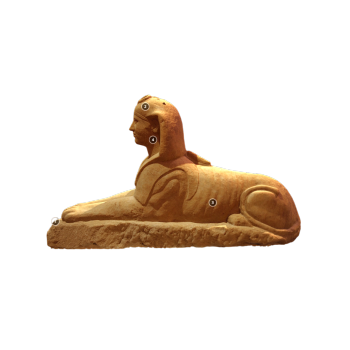
Egyptian Style Sphinx Statue
Strictly follow the Egyptian style Sphinx modeling specifications-the head is an idealized pharaoh's face (smooth eyebrow arch, deep eye sockets, apricot-shaped eyes, high nose bridge, full lips, tough jaw lines, with false beard symbolizing divinity); The head wears ancient Egyptian iconic headdresses (such as the Niemes scarf, with blue and yellow vertical stripes and holy snake decoration, symbolizing kingship and protection of gods); the body, the muscle lines are full and strong (broad chest, slightly bulging back and tight abdomen), with stout limbs, front paws stretched together, claws with clear details (clear toenails) and tail naturally curled on the side of the body.

An Egyptian eagle-headed sphinx hidden in the British Museum
This is a falcon head sphinx also known as the eagle-headed lion. It is a statue of a lion with a human face on its upper body and a falcon on its head. In ancient Egyptian religious beliefs, this image may have represented different deities or symbolism. The Sphinx usually symbolizes power and authority, while the eagle's head may be associated with the sky, the universe, or other mysterious aspects. Found in the temple of Ramses II in Abu Simbel, Egypt (Nubia), this is one of the pair. It is now in the British Museum in London.

Popular Models

Random Model

Warehouse pallet truck
675 View

F/A-18 Combat Attack
907 View

Grass embroidered ball potted plant
859 View


San Sebastian Monument
891 View

French Simple Blue Leather Sofa Bed
855 View


1993 Canon EOS Rebel XS DSLR camera
857 View